Beyond PRRS detection: understanding the full PRRS picture
Porcine Reproductive and Respiratory Syndrome virus (PRRSv) remains one of the most prevalent and economically important pathogens affecting swine populations.
Accurate, sensitive, easy-to-use assays are crucial in the management of PRRS as the genetic diversity and complexity of PRRSv are still causing increasing challenges for the swine industry.
Proper monitoring of PRRSv in conventional herds can greatly decrease the production losses associated with the disease.
Understanding the status of the herd, infection timepoints, optimal vaccination moment and vaccination success allows the veterinarian to implement the best-suited PRRS prevention strategy.
PRRS monitoring is about more than identifying positive or negative animals. Understanding how antibody responses evolve over time can provide valuable insight into vaccination success, field exposure, and infection dynamics within a herd.
Reviewing monitoring trends over time can provide valuable context that may not be apparent from a single test result alone.
The following field examples illustrate how serological monitoring can support more informed herd health decisions and complement other diagnostic tools such as PCR.
What monitoring data can reveal
Suspected field exposure
A sow herd showed unexpected changes in antibody profiles during routine monitoring. By comparing antibody responses over time and evaluating the results alongside PCR data, veterinarians gained a clearer understanding of the likely timing and nature of field exposure.
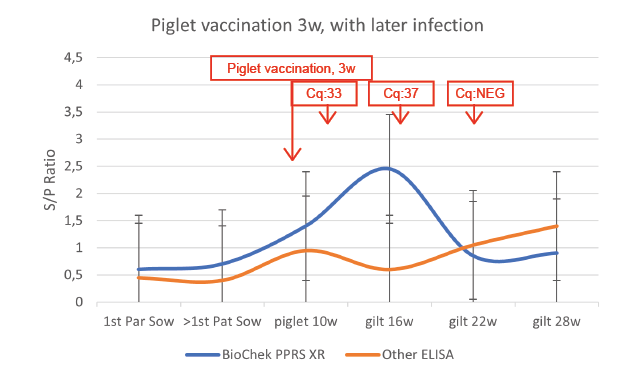
Figure below: example illustrating how monitoring trends over time can help differentiate between vaccination response, field exposure, and active infection.
Vaccination response or field exposure?
Interpreting serological data following vaccination can sometimes be challenging. This example demonstrates how monitoring trends over time can help distinguish between a normal vaccine response and potential field virus circulation.
Confirming active infection
In this case, changes in antibody profiles were observed before PCR results confirmed active infection. Together, the data provided valuable insight into the progression of the outbreak and supported timely management decisions.
Effective PRRS management requires more than a single test result. Combining serological monitoring, PCR testing, and field observations can provide a more complete understanding of herd health and support timely management decisions.